How process discovery works with process mining and AI
Process discovery reconstructs how a process really runs, from the event logs your systems already record (process mining) or from the people who do the work. Here is how each method works, what it delivers and what should act on the findings.
Process discovery is the work of finding out how a process really happens: which activities exist, in what order, who performs them, how long they take and where they get stuck. There are two ways to do it: from the data your systems already record, which is what process mining does with the help of AI, or by asking the people who do the work. This article explains how each one works, what it delivers, when one needs the other, and why discovery is only worth something when something acts on what it finds.
Process mining usually describes its method in three steps: discover, monitor and improve. Discovery is the starting point. Mining algorithms and AI techniques read the data in management systems and rebuild the business process as it actually runs, not as it was designed. Before getting into how, two basic concepts are worth pinning down: what a process is, and what an event log is.
What is a process?
A process is a series of interrelated tasks or activities carried out to reach a specific goal. In a business, a process might be every activity between issuing a purchase order and delivering a product to the customer. Each process is made of several steps that should happen in a certain sequence for the process to be efficient and effective.
A CFO at a health insurer, for example, is involved in the monthly financial close, which includes reconciling accounts, reviewing expenses and preparing financial reports. A director at a telecom company is involved in customer service, which includes answering calls, solving problems and following up with the customer.
What is an event log?
An event log is a detailed record of the activities that happen while a process runs. Each event contains information such as the activity performed, the actor (or resource) who performed it, the timestamp and other context data.
Think of each activity in a process as a footprint left in the sand. Each footprint has its own shape and leaves a trail that lets you follow the path taken. In process mining, an event log is exactly that: the digital trail left by each activity in a process.
Every event in a log has three mandatory fields:
- Case ID: the identifier of one specific instance of the process. In purchasing, the purchase order number is a case. In a hospital, the encounter number identifies the patient's visit.
- Activity: the name of what was done, for example "send invoice" or "approve order."
- Timestamp: the exact date and time the activity happened. Recording the start and end of an activity lets you analyze its processing time (the time someone spent actively working on it), also called execution time.
Events can carry other attributes as well, which add context and can be used in the analysis.
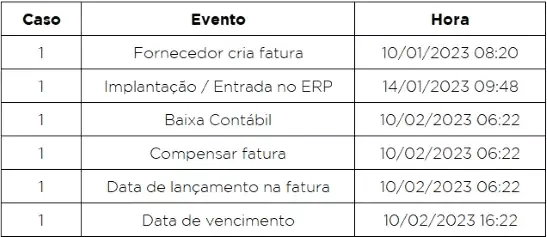
Event log
Event logs are generated automatically by many management systems, such as ERP (enterprise resource planning), CRM (customer relationship management) and MES (manufacturing execution system). These systems record each activity as it happens, building a detailed history that can be analyzed. In Brazil, that usually means the TOTVS Protheus and Datasul ERPs or SAP in procurement and finance, and Philips Tasy or MV in hospitals.
What is a process map?
A process map is a graphical representation of a business process. It shows the activities that make up the process, the flow between them and other relevant information, such as execution time and the people involved.
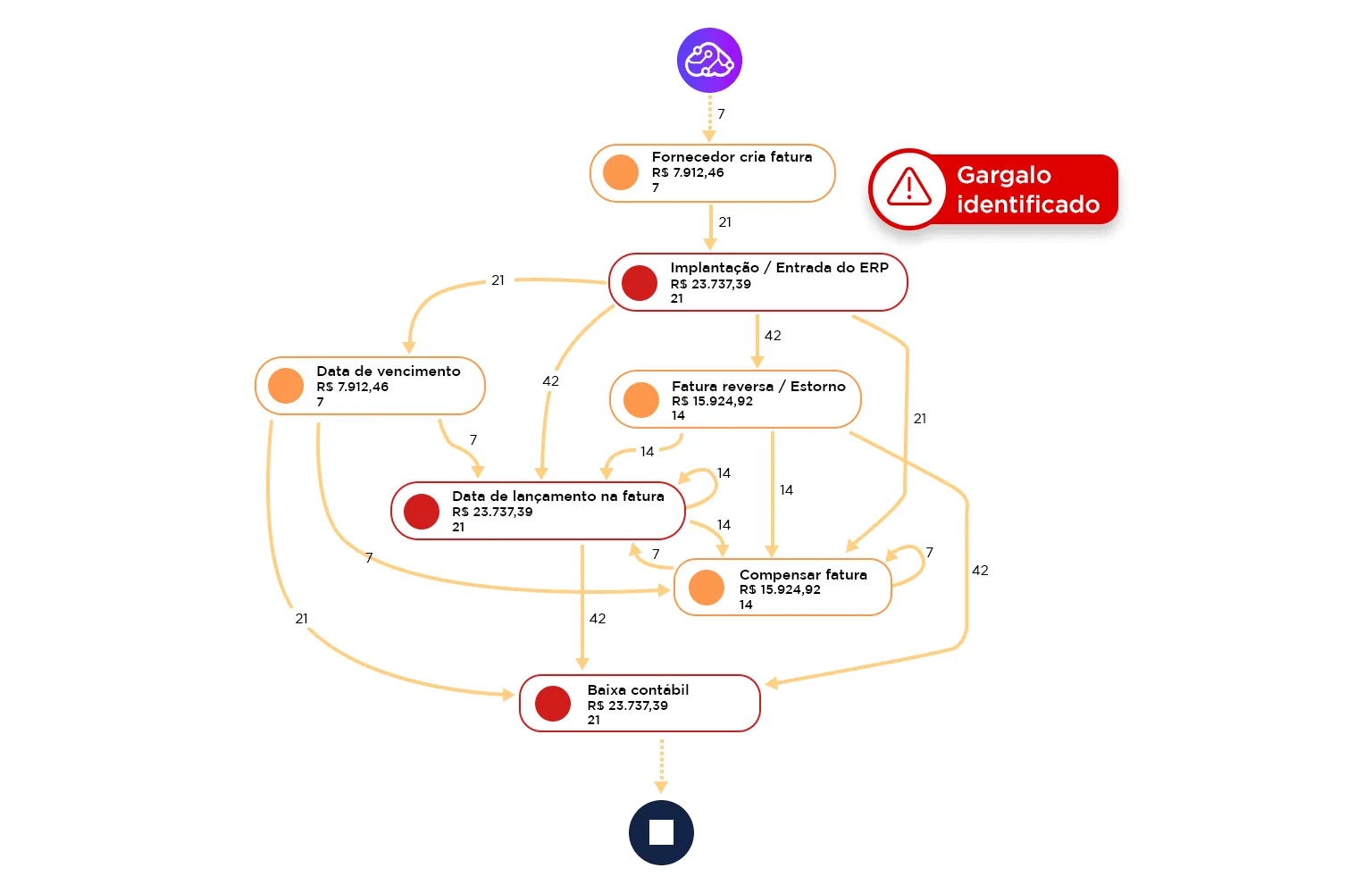
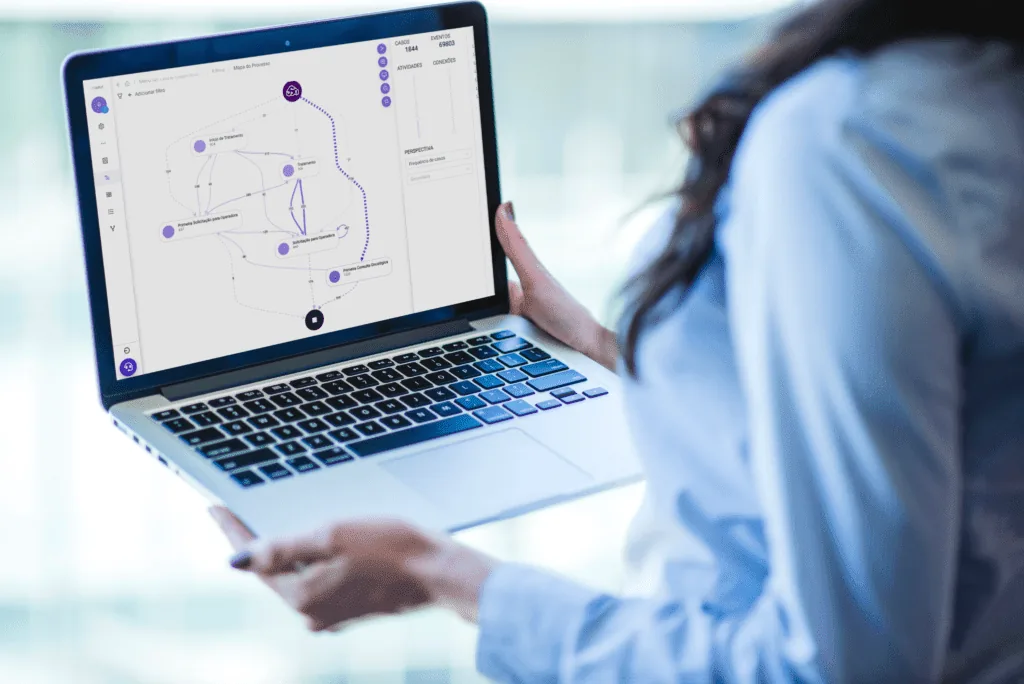
A process map in UpFlux Process Intelligence
In process discovery, the map is generated automatically from the event logs. That means it reflects the real process, not an idealized or theoretical one, which makes it a powerful tool for understanding how the process actually works and where it can be improved. Because it is built from large volumes of data rather than from a handful of conversations, a mined map shows variants and exceptions that a manual approach tends to miss.
What process discovery answers
Process discovery uses event logs to build a visual model of the business process exactly as it occurs. It goes beyond visualization: it shows the exact sequence of activities, the most common and the rarest paths, the bottlenecks and the deviations from the intended process.
In practice, it answers three questions. How is the process running? Where are the delays and inefficiencies? Are there deviations from the intended process?
At UpFlux, this is the job of Process Intelligence: process mining with AI applied to the ERP and hospital systems a company already runs. The model it builds shows not only the sequence of activities but also execution times, the people involved and the attributes of each case. It is also the reason UpFlux is the only Brazilian company in Gartner's Magic Quadrant for Process Mining.
How process discovery works
At its core, process discovery means collecting information about the activities that make up a process and the order in which they happen, so you can build a model that is easy to understand and analyze. There are two ways to collect it.
Manual process discovery
Done manually, process discovery usually involves these steps:
- Interviews: process analysts interview employees to understand how they do their tasks.
- Observation: analysts watch employees at work to capture details that don't come up in interviews.
- Document review: analysts examine the documents and systems employees use to understand the workflow.
- Process map: based on what was collected, analysts draw the process.
This method can give a detailed view, but it is slow and depends heavily on people's memory and interpretation, which leads to errors and omissions. It also gives a static picture and may miss variations and exceptions. If this is your route, use a process discovery interview guide so every conversation captures the same data.
Automated process discovery
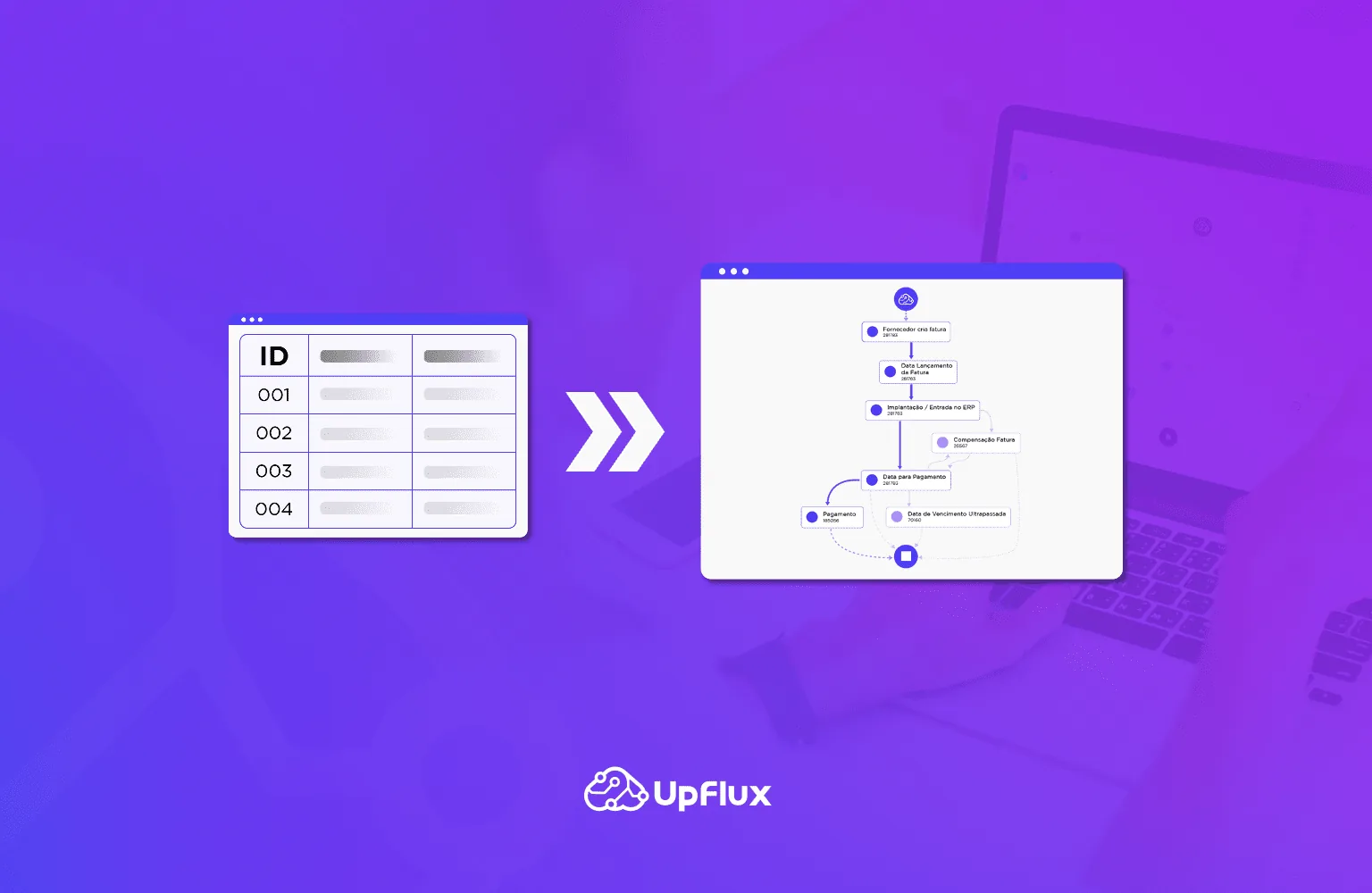
Process discovery with process mining is automated. It starts from event logs, which mining algorithms analyze to build the visual model of the process: every activity from end to end, the flow between them, execution times and the people involved.
Instead of interviews and observation, the steps are:
- Data collection: event logs are extracted from the company's management systems.
- Analysis: mining algorithms process the logs.
- Visualization: the result appears as a process model.
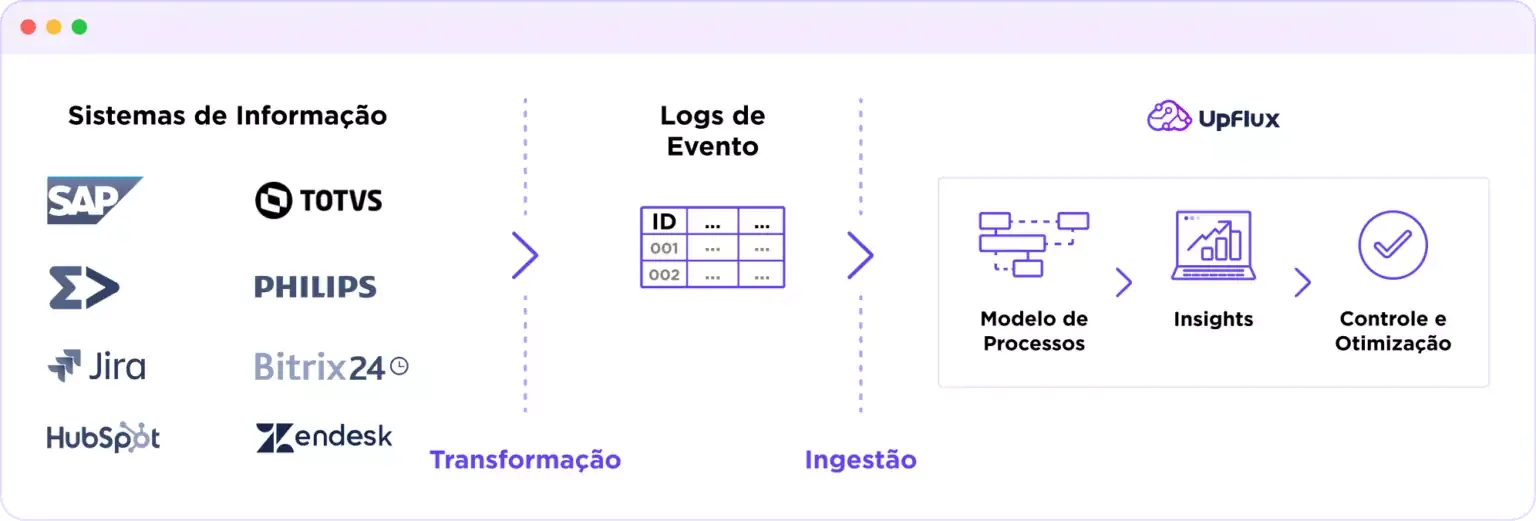
How process mining works, from consuming ERP data to turning it into process maps
AI adds to the mining itself: it lets the analysis cover large volumes of event data and build detailed models, which makes improvement opportunities easier to spot.
What process discovery delivers
The first step of process mining produces four results you can use to understand and improve a process:
- Process models. The most direct result is a visual model showing every activity, the flow between them and details such as execution time and the people involved.
- Bottlenecks. With the process visible, it is easy to see where the flow stops, causing delays and inefficiency.
- Deviations. Discovery shows where the real process departs from the intended one. Deviations can come from errors, inefficiency or non-standard ways of working.
- Improvement insight. Models, bottlenecks and deviations together point to where to streamline the flow, remove waste and improve compliance.
Discovery is not the finish line
Here is where the classic three-step method, discover, monitor and improve, falls short. It assumes that once a manager sees the bottleneck on a dashboard, someone will go fix it. In practice, the map shows the problem and the same overloaded team is left to act on it. Insight without execution is a nicer-looking report.
That is why, at UpFlux, process mining is the discovery layer of a broader Enterprise AI layer that has three jobs: understand, act and prove.
- Understand: Process Intelligence and Agent Mining. Process mining reveals the real process behind the ERP: variants, bottlenecks, rework. Agent mining applies the same technique to the AI agents themselves, so every decision they make can be traced.
- Act: Nous and the Intelligent Agents. Nous is the operational AI in day-to-day work: a conversational copilot, real-time management cockpits and agents that execute inside the ERP. The Intelligent Agents take on specific routines, such as prioritizing, expediting, reporting status and negotiating, within the approval rules the system already has.
- Prove: RoAI (Return on AI). RoAI measures, in hard currency, the return of every AI action and every agent, with an audit trail per decision.
In other words, what discovery finds becomes a queue of work that agents execute and that RoAI measures. This is also the main difference from process mining suites that stop at insight and hand execution to third-party integrations; the UpFlux vs. Celonis comparison lays it out point by point.
That layer is what sits underneath UpFlux's digital teams: AI agents operated by specialists that take over the transactional work of procurement and healthcare inside the systems companies already use.
Where process discovery applies
Process discovery applies to almost any sector where work leaves a trail in a system.
- Healthcare. In hospitals and health plans, discovery maps the patient journey, the bottlenecks in care delivery and the flow of claims. It supports real-time command centers that track the journey end to end, patient safety and bed turnover. On the payer side, it is the basis for medical claims audit that covers every claim instead of a sample, now used by more than 40 cooperatives in Brazil's Unimed System.
- Manufacturing. On production lines and in supporting processes, discovery reveals inefficiency and variability, helping cut waste and raise productivity.
- Retail. Retailers use it to streamline customer service, logistics and inventory management.
- Finance. In finance operations, it helps find savings opportunities, human error, rework and even fraud, and underpins order-to-cash work on billing and collections.
- Telecom. Telecom companies use it to improve service quality and allocate resources better. A common first finding is how much of the operation runs in a standardized way and how much varies case by case, which tells you where to standardize first.
The results page has anonymized cases with the numbers behind them.
What if the process isn't in any system?
Process mining has one condition: the process has to leave a log. Without a case ID, an activity and a timestamp recorded in some system, there is nothing to mine. In procurement, billing, production or hospital care, that record usually exists. In much of administrative work, it doesn't.
Think about what happens between one system and another. The spreadsheet someone keeps to check what the ERP doesn't. The email asking for approval. The follow-up on WhatsApp. The report built by hand every Monday. The data typed twice because two systems don't talk. None of that generates an event. On a mined map, that work shows up at best as a long gap between two activities, with no explanation of what happened in between.
That work only shows up one way: by asking the people who do it. That is manual discovery, with the limitations described above. A consulting firm typically hears from 8 to 12 people in about six weeks, because that is what fits in a consultant's calendar. The result is a sample, and samples tend to favor the manager and the most experienced staff, who are not always the people doing the task every day.
The more recent alternative is the process census by AI agent. Instead of a consultant interviewing a few people, an AI agent interviews everyone on the team, through a link, with no scheduling, in parallel. Each person describes their tasks, frequency, duration, the system they use and where it gets stuck. Accounts of the same task are consolidated so nothing counts twice, and the result comes out in hours per year per activity. That is what UpFlux's Nous Scan does: about 40 minutes per person, around two weeks for up to three areas, with no integration and no load on IT. Leadership sees only the consolidated view, never an individual interview. See how AI process mapping works.
The two approaches complement each other. The log shows what the system recorded. The interviews show what people do around it. Where perception and data disagree is usually where the best opportunity is. Both are doors into the same diagnostic, which returns the operation's target in currency in two weeks.
Frequently asked questions
What is process discovery?
Process discovery is finding out how a process runs in practice, as opposed to how it was designed. The result is a model of the real flow, with activities, sequence, times and owners. It can be done from system logs, with process mining, or from the accounts of the people who do the work.
What is the difference between process discovery and process mapping?
Discovery captures what happens; mapping represents it as a flow everyone can understand. In practice, discovery is the first part of process mapping: without it, the diagram shows the process the company thinks it has, not the one that actually runs.
How do you start process discovery?
Pick a process with a known pain and check whether it leaves a trail in a system. If it does, extract the log with case ID, activity and timestamp, and generate the map. If the work happens in spreadsheets, email and messages, start by listening to the people who do it, with the same questions for everyone.
How long does process discovery take?
It depends on the method. With a good-quality event log available, the first map can be ready in days, and what usually takes time is extracting and preparing the data. With interviews run by a consultant, expect weeks. A census run by an AI agent takes about two weeks for up to three areas.
Can process discovery be done with AI?
Yes, in two ways. In the data, mining algorithms and AI rebuild the flow from the logs and point out bottlenecks and deviations. Outside the data, an AI agent interviews people and consolidates their accounts into activities, frequencies and durations. One covers what the system records; the other, what it can't see.
What happens after process discovery?
In the classic process mining method, monitoring and improvement follow. At UpFlux, what discovery finds goes to AI agents that act on it inside the ERP, under the system's own approval rules, and RoAI measures the return of each action in hard currency.