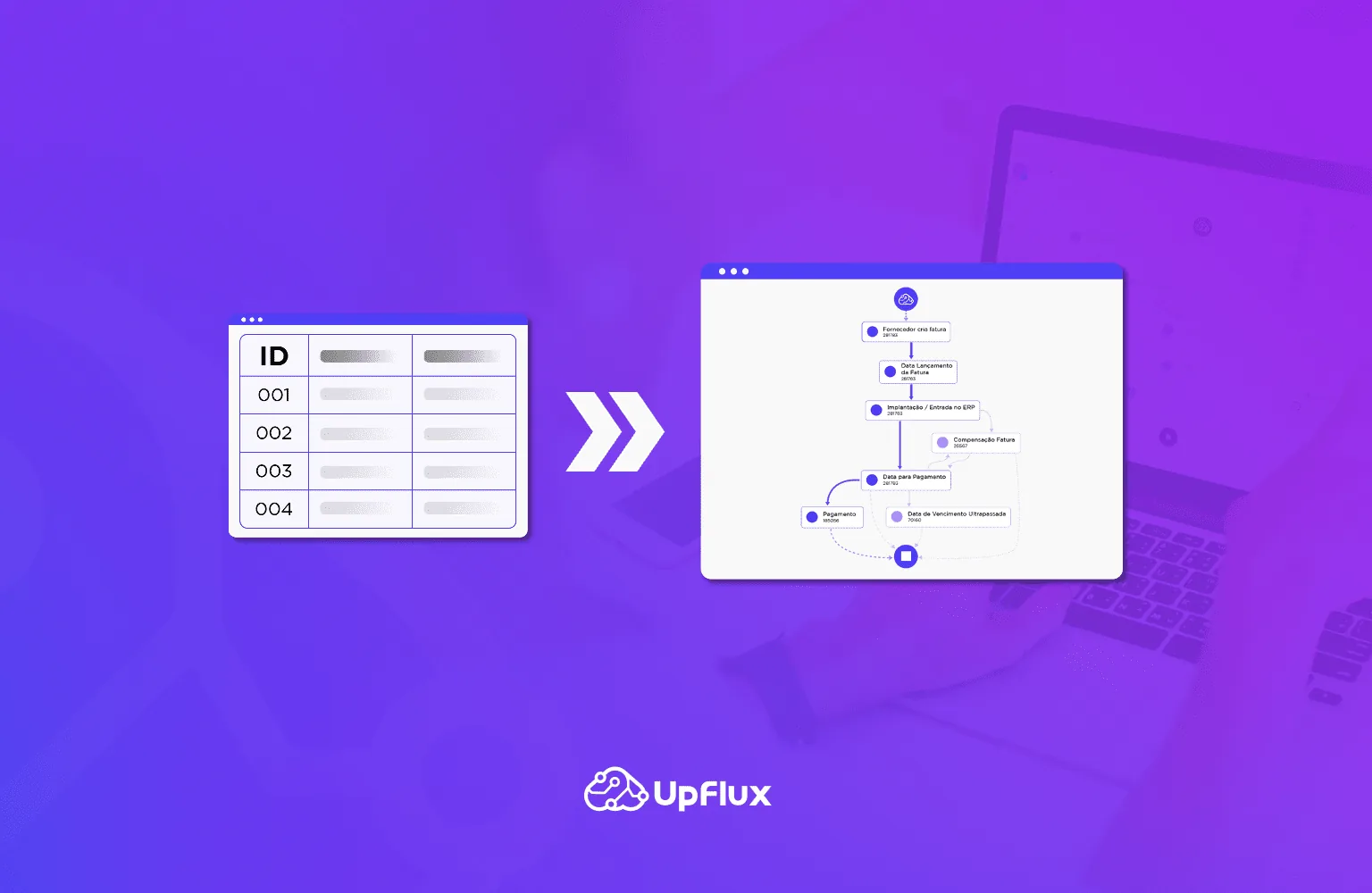
Process discovery interviews: techniques and a ready-to-use interview guide
Interviews are the process discovery technique that yields the most, as long as they follow a script. Here are the seven techniques compared, a complete interview guide with the exact questions, and a method to consolidate 30 accounts without counting the same task twice.
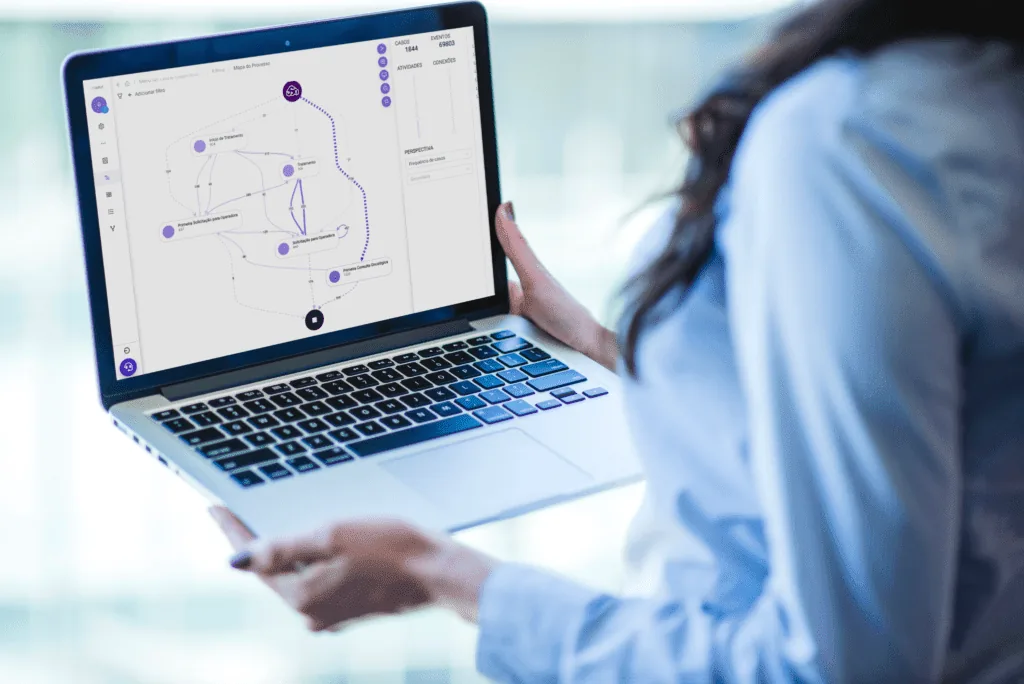
Process discovery (the Brazilian term is levantamento de processos) is the stage of process mapping where you find out how the work really happens: what people do, in what order, how often, for how long and where it gets stuck. The most common techniques are one-on-one interviews, workshops, direct observation, questionnaires, document review and system data analysis. Interviews yield the most, provided they follow a script, which is why this article includes one you can use as is.
Below you will find the techniques compared, the guide in blocks with the exact questions, how to conduct the conversation, a method to consolidate dozens of accounts, and the math on how long all of it takes. At the end, how an AI agent runs the same guide with every person at once.
What process discovery is and where it fits in process mapping
A process mapping project usually has four moments: define the scope, capture the current state, design and analyze, and propose the future state. Discovery is the second, and it feeds everything that follows. The drawing of the current process, the as-is, is only as good as the information collected before it.
It is also the most underrated stage. Most content on process mapping teaches you how to draw: notation, swimlanes, diagramming tools. Very little covers how to get the information that goes inside the boxes. The result is a set of good-looking flowcharts that describe the process the way the manager thinks it runs.
Good discovery delivers three things a diagram alone does not. The list of real tasks, including the ones nobody made official. The time each one takes, which turns a flow into a cost. And the exception points, which show where the process breaks and why.
Process discovery techniques: what each one captures
No technique sees everything. The choice depends on what you need to know, how many people are in scope and how much specialist time you have.
| Technique | Captures well | Captures poorly | Effort |
|---|---|---|---|
| One-on-one interview | Real routine, times, exceptions and their causes, invisible work | End-to-end view; depends on the respondent's memory | High per person: one hour of conversation plus one to two hours of structuring |
| Team workshop | Sequence across teams, handoffs, consensus on the flow | Time per task; quiet people disappear; nobody exposes a problem in front of the boss | Medium: few sessions, but hard to schedule |
| Direct observation (shadowing) | What people do without noticing, screen switching, interruptions | Monthly and yearly tasks; behavior changes when someone is watching | Very high: hours of specialist time per person observed |
| Questionnaire or spreadsheet | Reach: gets to everyone at once | Quality: vague answers, totals above 100% of time, periodic tasks forgotten | Low to distribute, high to clean up |
| Document review | Official rules, approval limits, policies, regulatory requirements | The gap between the manual and practice | Low |
| System data analysis (process mining, task mining) | Volume, cycle time, variants and bottlenecks, precisely and without relying on memory | Everything that happens outside the system: email, spreadsheets, phone; and the reason behind each deviation | High at the start: requires an event log, extraction and IT support |
| Census by AI agent | The same as the one-on-one interview, with everyone in scope | End-to-end view, which comes from consolidation rather than from each conversation; depends on the respondent's memory | Low per person: does not grow with the number of respondents |
Some combinations work better than any single technique.
Interviews and system data complement each other. The log says an invoice took nine days to be approved. The interview says it was because the approver only opens the system on Fridays. When you have both, cross them: where perception and data disagree is usually where the most valuable finding sits. When there is no log, or the work happens in email and spreadsheets, the interview is the only source. The article on process discovery with process mining goes deeper into the data side.
Workshops are for validating, not for discovering. Gathering the team to capture the process from scratch produces the official process, narrated by whoever talks loudest.
Interview guide for process discovery
The guide below has seven blocks and fits in 45 to 60 minutes. The questions are written the way they should be said. Adapt the vocabulary to the team, but keep the order: it is designed to start with the concrete and only then ask for estimates.
Block 1. Opening and consent (3 minutes)
People need to know what the conversation is for and what happens to what they say. Without that, you hear the job description, not the routine.
- "This conversation is about understanding how the team's work happens day to day: what takes time, what gets stuck and what could be simpler. It is not a performance review."
- "What you tell me goes into a consolidated view of the team. Your individual answers will not go to your manager, and your name will not appear in any report."
- "You don't need to name colleagues. If you mention someone else, use their role or their team."
- "There is no right answer. If you don't know a number, give me your best guess and I'll write it down as an estimate. Shall we start?"
Only promise confidentiality if it is true. Agree with the sponsor, before the first interview, that they will receive only the consolidated view.
Block 2. The routine, through yesterday (10 minutes)
- "Walk me through what you did yesterday, from the start. You arrived, you turned on the computer. What was the first thing?"
- "And after that?"
- "Was yesterday a typical day? What is usually different on a normal day?"
- "Is there anything you do almost every day that you didn't do yesterday?"
Write down each task as a verb plus an object: "post invoice," "check bank statement," "reply to supplier." Don't stop to drill into details yet. In this block, the goal is the list.
Block 3. The detail of each task (20 minutes)
Start with the task that seemed heaviest and repeat the sequence for the five or six main ones.
- Trigger: "What makes this task start? An email arrives, someone asks, it's a fixed time?"
- Frequency: "How many times does this happen on a normal day? And on the worst day of the month?"
- Duration: "Think about the last time you did it. How long did it take, start to finish?"
- System: "Where do you do this? Which screens or files are open?"
- Input: "Which team or role sends you what you need to start?"
- Output: "When you finish, which team or role does it go to? What do they do with it?"
Block 4. What goes wrong (8 minutes)
- "In this task, what usually goes wrong?"
- "Out of ten times, how many does that happen?"
- "When it happens, how much extra time do you spend? What do you have to do to fix it?"
- "Is there anything you check or redo as a precaution, because it went wrong before?"
- "Do you keep your own control, a spreadsheet or notes, so you don't have to rely on the system?"
Block 5. What is periodic (5 minutes)
People answer with last week in mind. This block recovers what fell outside it.
- "What changes in your routine at month end? Is there a close, a report, a reconciliation?"
- "And at quarter end or year end? Inventory, budget, audit, some annual obligation?"
- "How much time does each of these take, adding up every day you work on it?"
- "Is there a time of year when the volume doubles?"
Block 6. What shouldn't be yours (5 minutes)
- "Is there anything you do that, in your view, shouldn't be part of your role?"
- "If you could stop doing one task tomorrow, which would it be? Why?"
- "Is there a recurring meeting where you mostly listen rather than decide? How much time does it take per week?"
- "Have you or anyone on the team built a shortcut, a macro, a template or an automation to save time? What does it do?"
The last question prevents a common mistake: proposing as new something the team has already solved on its own.
Block 7. Validation close (5 minutes)
Read the list back, with the times.
- "Let me check what I wrote down. You post about 25 invoices a day, at around 6 minutes each. You reconcile the bank statement once a day, in 40 minutes. You build the payment file three times a week, 50 minutes each. You answer about 12 supplier contacts a day, 5 minutes each. Is that right?"
- "Adding it all up, that's close to 5 hours of your day. Does that sound right? What takes up the rest?"
- "Did I miss anything important?"
Adding it up out loud is the most valuable step in the guide. When the total goes above eight hours, the person points out where they overestimated. When it lands at three, they remember what was missing.
Interview technique: how to hear the real routine
The guide is half the work. The other half is how you run the conversation.
Start with the heaviest task. The respondent's attention drops after half an hour. If you follow the chronological order of the day, you will spend the best part of the conversation on "I open my email." Ask "which of these takes the most time?" and detail that one first.
Ask for the concrete case, not the average. "How long does it take, on average?" produces a number made up on the spot. "The last time you did it, how long did it take?" produces a memory. Then calibrate: "was that a normal case or a complicated one?"
Never ask for third parties' names. Discovery is about the process. If the person says the invoice gets stuck "with Carlos," write down "at the requesting manager's approval." Asking for names turns the interview into a complaint session, and the next person in line will arrive already knowing it.
Don't suggest the answer. "That takes about ten minutes, right?" becomes "yeah, about that." Ask the open question and sit through the silence. If the person can't estimate, offer wide ranges: "is it closer to five minutes, half an hour or two hours?"
With people who summarize too much, go back to the concrete. Answers like "I handle payments" are common among long-tenured staff, because the routine has become automatic. Try: "picture the last payment file you built. What was the first click?"
With people who wander, use the list as an anchor. Interrupt respectfully: "that's important and I've noted it. To close out this task: how many times a week?" Closed questions about frequency and duration bring the conversation back.
Record the person's own words for "where it gets stuck." Don't translate them into process jargon. "The supplier sends the invoice to the requester's email, and we only find out on the due date" is more useful than "failure in fiscal document intake."
How to consolidate 30 interviews without counting the same task twice
If each person reports 10 to 15 tasks, thirty interviews produce somewhere between 300 and 450 lines. Adding everything up directly is the most expensive mistake in discovery, for two reasons. Different people describe the same task in different words. And people in neighboring teams each describe their own end of the same task. The method below solves both.
1. Standardize before you add. Rewrite each line as a verb plus an object, in the same unit. "Enter invoice," "post invoice" and "register service bill" are the same task if the object, the system and the output are the same.
2. Merge accounts of the same task within the team. If four analysts post invoices, that is one task with four people doing it, not four tasks. The task's volume is the sum of the individual volumes. The duration is the median of the accounts, not the mean, so one inflated account doesn't drag the number.
3. Don't merge what is different. The same verb can hide distinct work. "Reconcile," in accounts payable, means checking the bank statement. In accounting, it means closing supplier accounts. The test is the pair of system and output: if they change, they are separate tasks.
4. Watch out for shared volume. If the analyst says "I post 25 invoices a day" and the coordinator says "the team posts 100," both are talking about the same volume. Use the account of the person doing the work for time, and the coordinator's as a check on the total.
5. Separate floor and ceiling. The floor is what at least two people confirmed independently. The ceiling is everything reported, including what only one person mentioned. Present both. The floor is the number you defend in front of finance. The ceiling shows how far the gain can go if the single accounts are confirmed.
6. Connect the ends. One task's output should be another task's input. When accounts payable says it receives the invoice "from the requester" and no requester reports sending invoices, there is a gap: either someone wasn't interviewed, or that handoff happens informally. The gaps are where the flow between teams shows up.
7. Run a sanity check per person and per team. Add up each respondent's hours per year. On an 8-hour workday, the year has around 1,840 hours once vacation is taken out. Someone who adds up to 2,600 overestimated. Someone who adds up to 600 forgot half. Go back to those people before closing.
8. Flag what is already automated. A task the team has already solved with a macro or an integration goes on the list with zero gain. It keeps you from promising the same savings twice.
Only after that does it make sense to calculate cost and classify what to eliminate, simplify or automate.
How long it takes with a human interviewer (and why that limits coverage)
The math is rarely done before the project starts.
Example, with the assumptions stated: a team of 30 people, one dedicated process analyst, 60-minute interviews.
| Item | Assumption | Hours |
|---|---|---|
| Schedule and prepare | 30 min per person | 15 |
| Interview | 60 min per person | 30 |
| Transcribe and structure into a table | 60 min per person | 30 |
| Consolidate, merge accounts, connect handoffs | 20 h for the whole set | 20 |
| Go back to people who failed the sanity check | 8 people × 30 min | 4 |
| Total | 99 |
That is 99 hours of specialist time, or about 12 working days of full-time dedication. On the calendar, it takes longer. Interviews depend on the respondents' schedules, and more than four a day rarely fit with quality. Vacations, month-end close and rescheduling push the timeline out. At an average of two to three interviews per working day, rescheduling included, the conversation phase alone takes two to three weeks. Adding preparation, consolidation and follow-ups, a 30-person project lands between four and six weeks.
With 100 people and the same assumptions, you get 250 hours of interviewing and structuring, plus a consolidation effort that grows faster than proportionally. Close to two months of one specialist doing nothing else.
That is why traditional diagnostics work with samples. A consulting firm hears from 8 to 12 people in about six weeks, because that is what fits in a consultant's calendar, and extrapolates to the rest.
The sample has a price. The people chosen tend to be the most experienced, with the least representative routine. The two-confirmation floor becomes hard to reach when only one person per role was heard. And rare tasks, the ones only one person knows how to do, are left out by the luck of the draw.
How an AI agent runs the same guide with 100% of the people
The guide in this article is structured enough to be run by an AI agent, and that is what makes the process census by AI agent possible: instead of a sample, an interview with everyone in scope.
It works like this. Each person gets a link and talks to the agent whenever they can, with no scheduling. The agent follows the same blocks: it opens by explaining the purpose and confidentiality, asks about the routine, details task by task, asks what goes wrong and what is periodic, and closes by reading the list back. Because the conversations happen in parallel, hearing 100 people takes the same calendar time as hearing 10. The cost no longer grows with the number of interviews.
That is what Nous Scan, from UpFlux, does. The interview takes about 40 minutes per person and captures task, frequency, duration, system used and where it gets stuck. Leadership never sees an individual interview, only the consolidated view.
Consolidation, the heaviest part of the manual work, is also done by the tool. Accounts of the same task are merged, handoffs between teams are drawn from what each person said they receive and deliver, and hours per year become R$ per year with the cost-per-hour assumption printed. The result separates floor from ceiling.
What Nous Scan delivers is an improvement queue prioritized by impact and effort, with four kinds of finding: a process that goes in circles and can be fixed without technology, a task where an AI agent delivers, hours spent by people who only sit in and watch, and what the team has already automated on its own, which counts as zero. For up to three areas, the typical timeline is about two weeks: one day of alignment, seven of census, two of consolidation and three of numbers. It requires no integration and puts no load on IT. ERP data, when available, comes in as an optional cross-check layer.
What the agent does not replace is the decision: someone still has to choose where to start and lead the change with the team.
If you are running discovery with your own team, the guide above is yours: copy it, adapt it and use it. If the scope goes beyond a few dozen people, take a look at AI process mapping or request a diagnostic.
Frequently asked questions
What is process discovery?
It is the stage of process mapping where you collect information about how the work happens today: tasks, sequence, owners, frequency, time, systems and failure points. It comes after scoping and before drawing the current process. The quality of everything that follows, from the flowchart to the improvement proposal, depends on what was collected at this stage.
What are the main process discovery techniques?
The most common are one-on-one interviews, team workshops, direct observation, questionnaires or spreadsheets, document review and system data analysis, which includes process mining and task mining. More recently, the census by AI agent has emerged, applying the one-on-one interview to everyone in scope in parallel.
How many people should you interview in process discovery?
Ideally, everyone who executes the process, because people in the same role tend to have different routines. When the interviewer's time is the constraint, the minimum you can defend is two people per role, so each task can be confirmed by more than one account.
How long should a process mapping interview last?
Between 45 and 60 minutes is enough to cover the opening, the routine, the detail of the five or six main tasks, exceptions, periodic activities and the final validation. Under 30 minutes, the block on monthly and yearly activities usually gets sacrificed. Over 75 minutes, the quality of the estimates drops, and it is better to schedule a second conversation.
How do you keep respondents from hiding process problems?
Explain the purpose right at the opening, make it clear it is not a performance review, and guarantee that individual answers do not reach management, only the consolidated view. Don't ask for colleagues' names and hold the interview without the manager in the room. Questions about recent facts, like what the person did yesterday and what went wrong last time, get franker answers than opinion questions about the process.
What is the difference between process discovery and process mapping?
Discovery is collecting information, and mapping is the full job, which includes discovering, drawing, analyzing and proposing improvements. In everyday language the terms appear together because one does not exist without the other. The common mistake is to invest in the drawing and skimp on discovery, which produces a flowchart that is right in form and wrong in content.